
A soggy lawn in Mobile, AL is rarely a mystery once you look at two things: the shape of your lot and the soil under it. Get those right and the drainage plan almost designs itself. Guess at them — or copy a plan built for some other part of the country — and you dig twice.
Two Different Wet Yards in Mobile
Mobile has two distinct wet-yard problems, and they need opposite fixes.
The first is the water-table yard. On the low, flat, deeply weathered ground that covers much of Mobile County — around the city and out through Prichard, Saraland, and the southern bottoms — the soil is sandy loam over a clay-enriched subsoil that traps water. On the poorly drained spots the seasonal water table climbs to within a foot of the surface through the cool, wet months. These yards stay spongy for weeks at a time and squish when you walk on them. The fix reaches into the ground.
The second is the runoff yard. On the sandy uplands — much of West Mobile, Semmes, Tillmans Corner — the ground actually drains well; in fact Mobile County’s single most common soils are the well-drained sandy uplands, not the wet flats. Standing water there is a surface problem: a flat spot that will not shed, a downspout dumping at the wrong place, or runoff sheeting off a driveway or a neighbor’s higher lot. The fix moves water across the ground and off the property.
Telling these apart is the whole game, and it is why we start with a walk-around instead of a product.
The Drainage Systems We Install
Once we know which problem you have, the toolkit is straightforward:
- Catch basins and channel drains collect surface water at a low point or across a driveway apron and pipe it away.
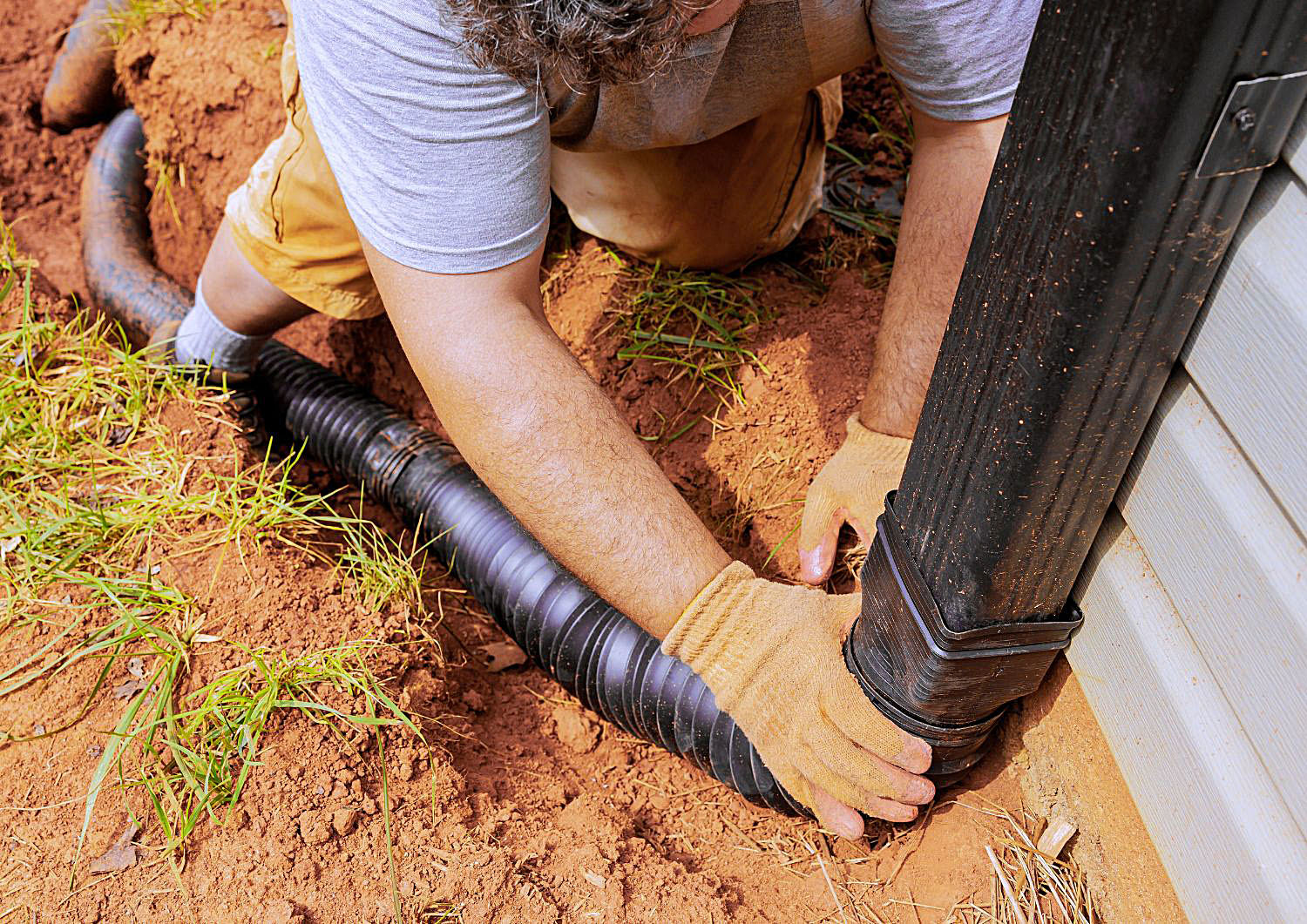
- Downspout extensions carry roof water — the single biggest surge most yards see — well past the foundation instead of dumping it in the same low corner every storm.
- Dry wells give piped water a place to disperse underground on lots with no good daylight outfall.
- Regrading rebuilds gentle surface fall so water leaves on its own, used where the slope itself is the problem.
- French drains intercept subsurface water and the high winter water table on the wet-flat lots.
Most real yards get a combination — a catch basin at the low spot, downspouts rerouted, and a French drain where the ground stays saturated.
Sizing the System to Your Lot
The Gulf Coast throws a lot of water at these yards — about 67 inches of rain a year (NOAA/NCEI 1991–2020 normal), with the heaviest months in summer and a spike whenever a tropical system tracks through. A drain that is undersized for that volume simply overflows in the storm you built it for. We size pipe, basin, and outfall to your roof area, your lot, and where the water can actually be sent — not to a generic template. That is also why we never quote a system sight unseen: two yards on the same street can need very different plans.
What Standing Water Does to a Yard
Left alone, a chronically wet yard is more than an eyesore. It kills turf and shallow-rooted plantings, keeps water pressed against your foundation and slab, breeds mosquitoes through the warm months, and turns a usable back yard into a no-go zone for half the year. None of that improves on its own, because the underlying cause — your grade and your soil — does not change. Drainage is what changes the outcome.
If your Mobile yard holds water and you are tired of working around it, the first step is figuring out which of the two problems you actually have. That takes a look at your lot, not a phone quote — and it is where every good drainage plan starts.